Capital project data management
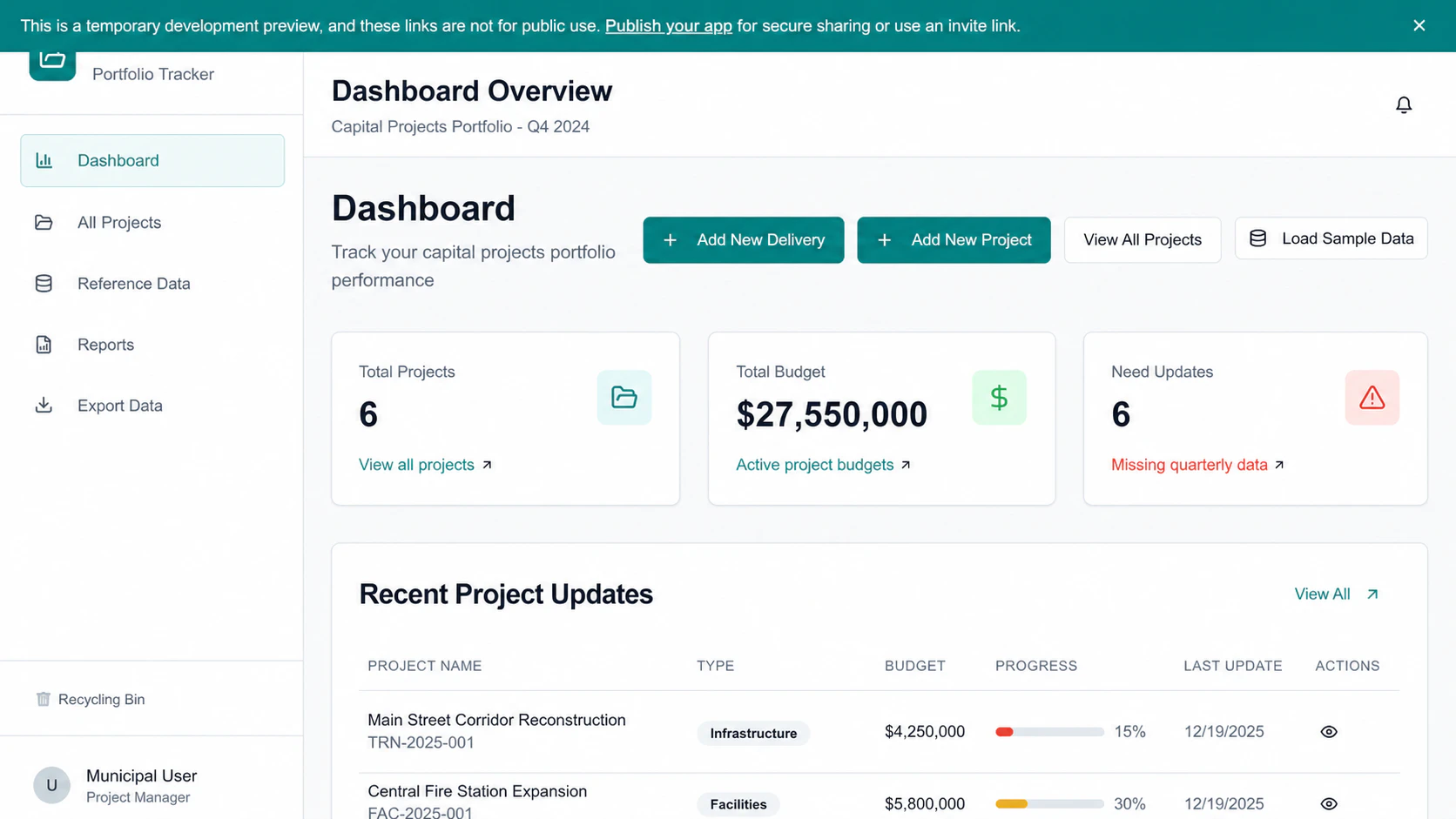
Collect a consistent quarterly update for every voter-approved capital project, including budget, actual spending, estimates, encumbrances, schedule, milestones, risk, and management narrative.
Municipal bond program management and reporting
BondIQ is a municipal bond program management and reporting platform for cities overseeing voter-approved capital projects. It unifies project updates, budgets, spending, schedules, milestones, and risks in one governed source for internal oversight, public transparency, and debt planning.
After voter approval
City managers, finance leaders, elected officials, bond oversight committees, and residents need current answers about every voter-approved project, including funding, spending, schedules, progress, and risk.
 One bond, many owners
Projects span departments, funding sources, and delivery teams. BondIQ keeps them aligned within one program.
Comparable quarterly updatesStandard inputs make project budgets, schedules, progress, and risks easier to compare.
Actionable oversightCity leadership sees the projects and financial issues that require attention.
Transparent public reportingResidents can connect voter-authorized dollars to project progress and next steps.
Municipal bond program software
Project teams submit consistent quarterly updates. Bond program, finance, and executive staff use the same current data for portfolio oversight, Power BI reporting, public transparency, and debt-service planning.
Municipal bond portfolio oversight
Give city leaders one current view of voter-approved projects, total program budget, quarterly reporting status, and items requiring follow-up.
The BondIQ municipal bond reporting system
BondIQ combines capital project data management, quarterly debt intelligence, public Power BI transparency, and internal Power BI oversight around one governed source of municipal bond program data.
Collect a consistent quarterly update for every voter-approved capital project, including budget, actual spending, estimates, encumbrances, schedule, milestones, risk, and management narrative.
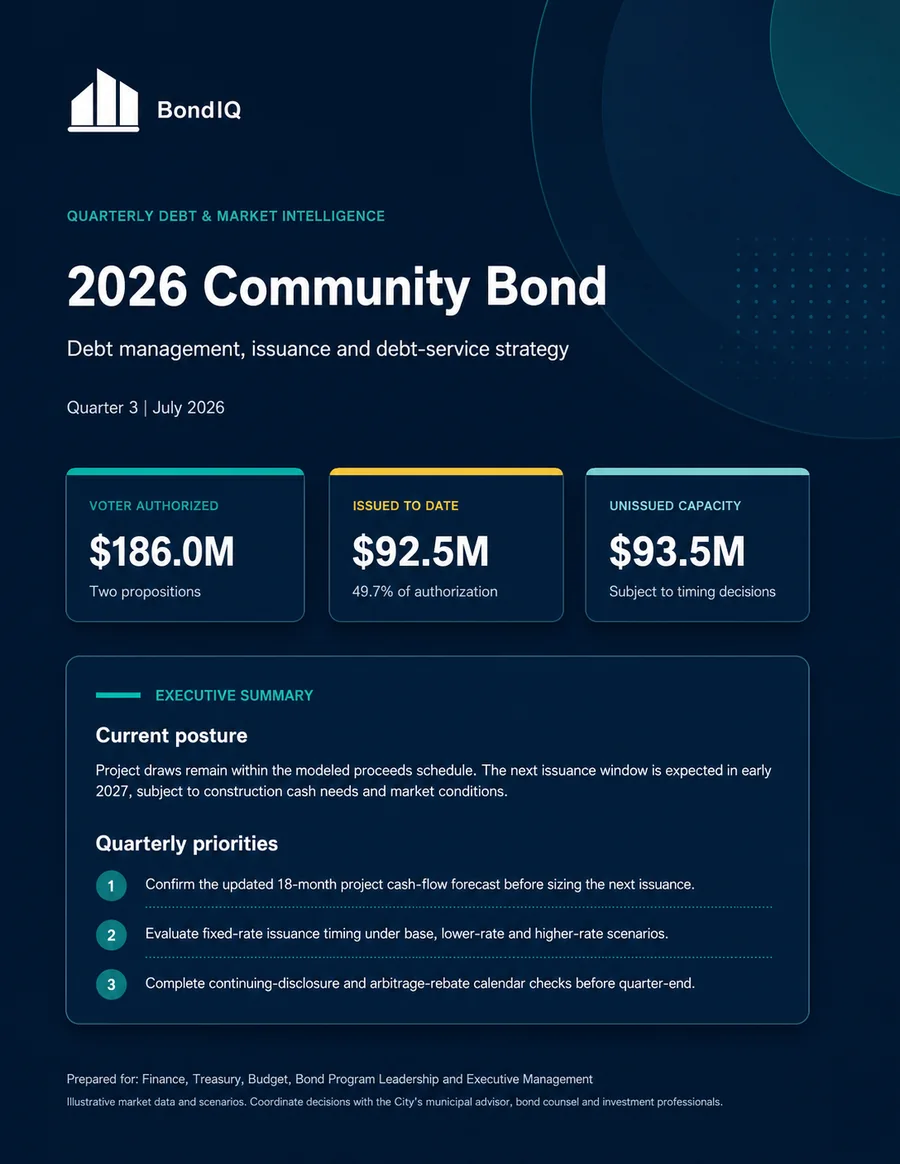
Give finance and bond program leaders a quarterly briefing on bond authorization, issuance, proceeds, debt service, market conditions, and upcoming financing decisions.
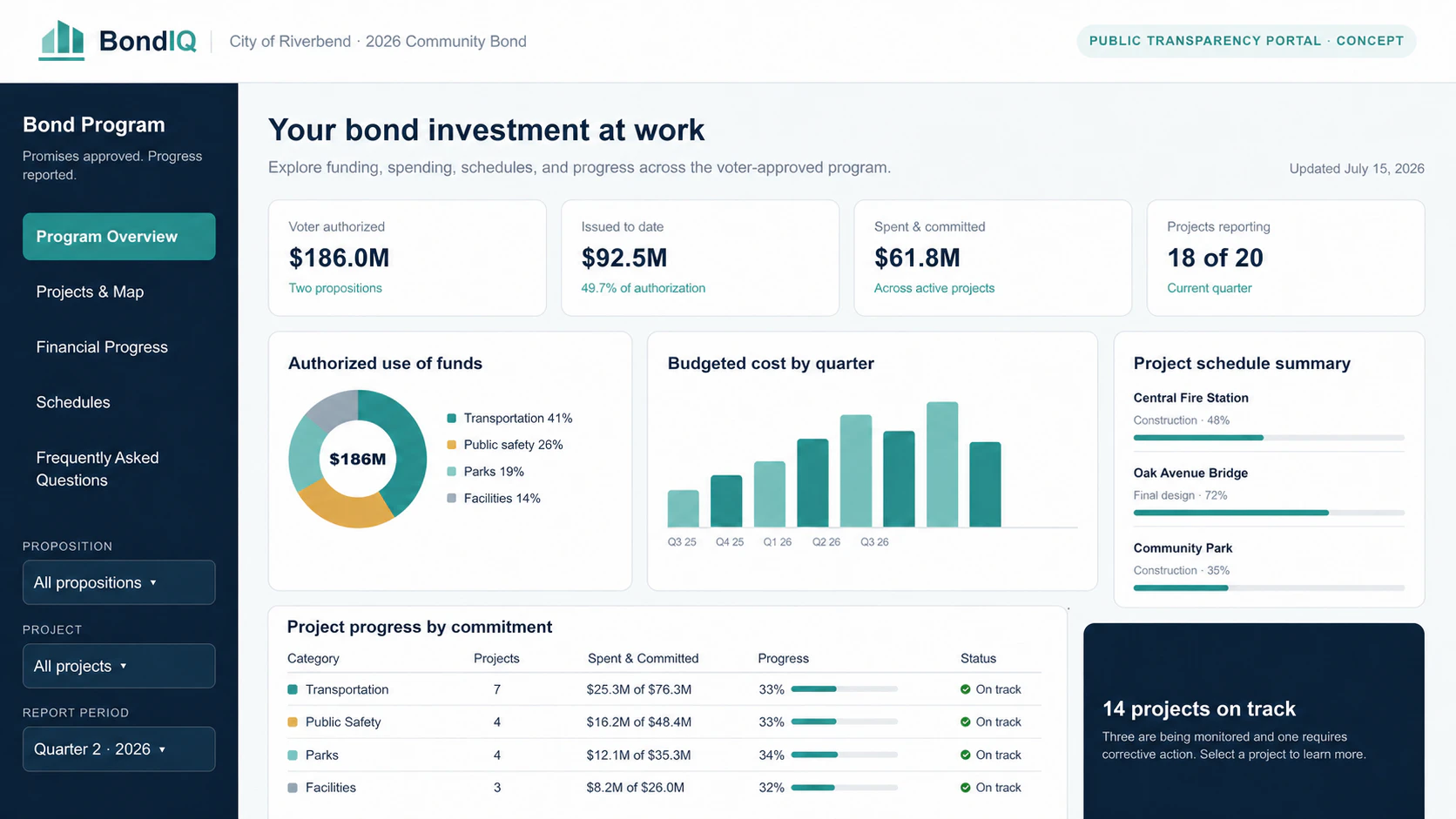
Give residents a city-branded Power BI report showing what voters approved, how bond funds are being used, where projects stand, and what comes next.
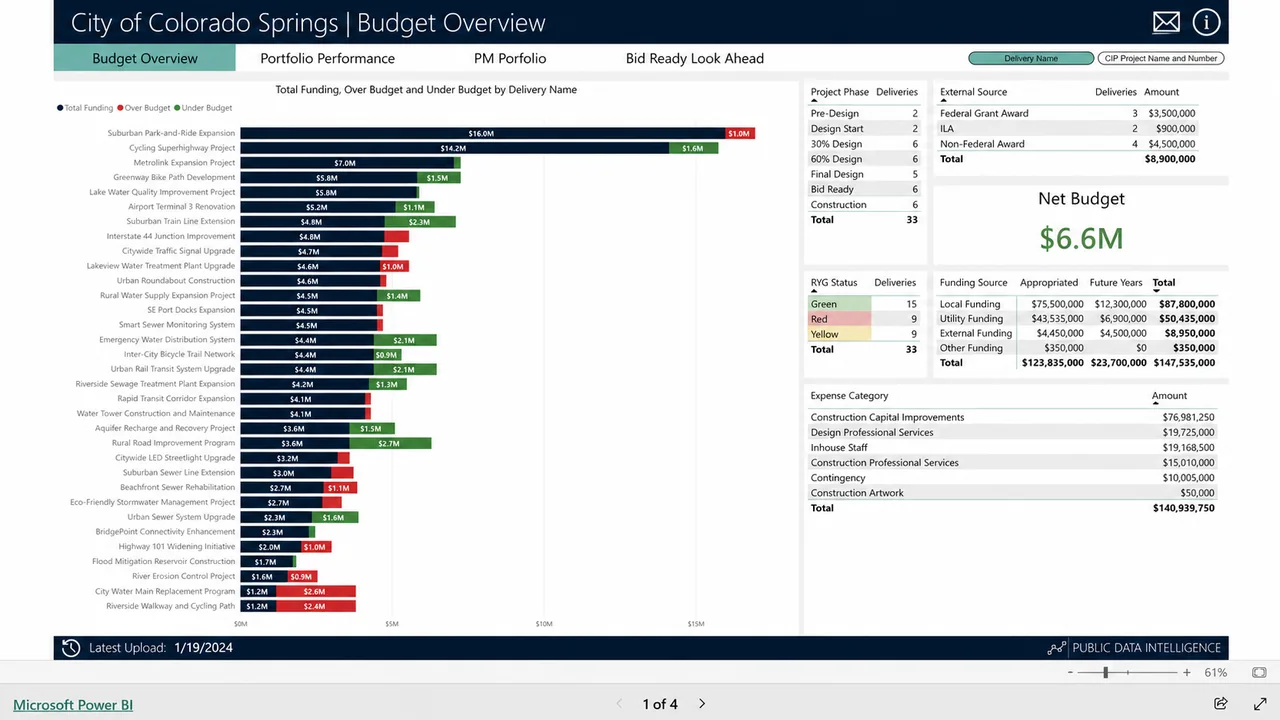
Give authorized staff and city leadership a secure Power BI view of bond program financial posture, project delivery, risk, and management exceptions.
Municipal bond program software FAQ
BondIQ is designed for the financial, operational, and public reporting realities of municipal bond programs.
BondIQ is municipal bond program management and reporting software for cities. It connects voter-approved capital project updates, budgets, spending, schedules, milestones, and risk in one governed dataset that supports internal Power BI oversight, public transparency, and quarterly debt intelligence.
A city can implement BondIQ while preparing a bond election to organize proposed projects, cost estimates, funding assumptions, and public messaging, or after voter approval to establish quarterly project reporting, financial oversight, public transparency, and debt-planning discipline.
No. BondIQ is purpose-built for municipal bond programs, but projects can combine bonds with grants, utility revenues, general funds, and other funding sources. Cities may use it for a voter-approved bond portfolio, a broader capital improvement program, or both.
No. Municipal financial systems record transactions, but they typically do not hold current project cost estimates, delivery schedules, milestones, or management narrative. Project management software and Excel templates may track delivery, but often lack the bond funding, spending, encumbrance, and budget context finance and leadership need. BondIQ bridges both systems, combining capital project delivery and financial detail into one governed source of municipal bond program intelligence.
BondIQ is configured around the city's proposed or voter-approved projects, project managers, districts, funding sources, expense categories, delivery phases, risk definitions, and reporting calendar. Quarterly submissions then capture the financial, schedule, progress, risk, and narrative information the bond program needs.
The internal experience is designed for management and oversight, with deeper financial, workload, risk, and exception detail for authorized staff. The public experience is city-branded and resident-friendly, emphasizing voter authorization, use of funds, project progress, schedules, and plain-language context.
The planned automated briefing combines bond authorization and issuance status, proceeds and remaining capacity, debt-service schedules, market benchmark movements, scenario-based rate outlooks, upcoming financing decisions, and key disclosure or compliance dates. It supports staff judgment and advisor conversations; it is not a substitute for municipal advisory, legal, tax, or investment advice.
BondIQ scope and pricing depend on the number of projects, available data, integration needs, internal reporting requirements, and public transparency goals. A discovery session defines a right-sized municipal bond program implementation.
Use BondIQ during municipal bond planning to organize proposed projects, cost estimates, funding assumptions, and public messaging. Then carry that governed foundation into project delivery, financial oversight, debt planning, and public transparency.